🚀 The Breakthrough: “Let Inertia Throw the Club, Not Your Hands”
I’ve spent a lot of time recently using Golf Swing AI to break down my mechanics. While trying to fix two chronic issues—my “over-swing” (the club traveling too deep and far behind my body during the backswing) and “casting”—I finally found the definitive answer to the role of both hands.
1. The Issue Flagged by AI: “Too Deep, Too Much”
According to the AI analysis, my clubhead was dropping too far behind me at the top of the backswing. Working to fix this naturally cured my casting habit (where the wrists uncock too early), but it left me with a lingering question: “How exactly am I supposed to use my right hand?”
2. The Paradigm Shift at Impact: “Stay Open to Square Up”
In the past, I tried to force the clubhead square at impact, often trying to rotate my left hand counter-clockwise on the downswing. Today, however, I realized the core secret is actually to go into the ball with the feeling that the face is remaining completely open.
The Law of Inertia: If I enter the impact zone feeling like the face is still open, the shaft compresses aggressively and rotates purely on its own due to momentum right after passing the ball.
Passive Action: Neither the left nor the right hand needs to force an artificial maneuver at the exact moment of impact. It’s about surrendering to the natural movement of the club.
Hand-First Position and Lag at Impact
This image perfectly visualizes the sensation of “entering with an open feel but getting compressed by inertia.” Notice how the hands lead ahead of the clubhead at impact.
Note: Keep in mind that while the left hand slows down slightly, it never stops at a single point—it must continue to move through.
3. The Perfect Relay: “Pull and Press”
Before and after impact, each hand delivers a completely different type of energy to maximize distance:
Hand
Role
Timing
Left Hand
Pulling Force
From the top of the backswing down to impact
Right Hand
Pushing/Pressing Force
From impact through the follow-through
When these two forces merge seamlessly, the arm-and-wrist triangle maintains a “stabbing motion” toward the target right through the hitting zone. You don’t have to force the contact; inertia turns this into the primary engine that launches the ball a long way.
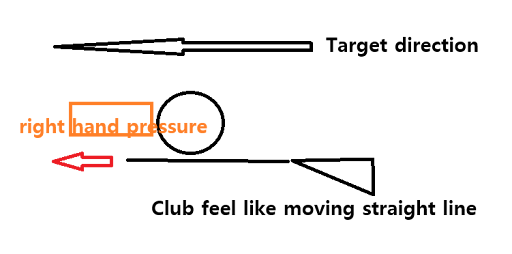
My Key Takeaway: Even though the swing is an arc, the feel must be a straight line toward the target. The “Right Hand Pressure” (orange box) is the secret sauce to compression.
4. Key Takeaways: The Realization Points
Don’t try to force the clubhead closed: Maintaining an open feel allows inertia to create a powerful, automatic rotation.
Maintain the Triangle: Keep the sensation of the hands forming a triangle that drives straight down the target line before and after impact.
The Relay of Energy: Just as the pulling force of the left hand completes its job, the pushing pressure of the right hand must naturally take the handoff.
The AI analysis set the blueprint for my swing path, and my sensory focus taught me exactly what my hands need to execute within that path. I no longer feel like I am forcing a mechanical swing; instead, I feel a step closer to a true “throw,” utilizing the weight and inertia of the club.
I drew the diagram below to map this out: The Geometry of Impact as I Felt It
The Technical Value of the Diagram (As Validated by Gemini)
While this drawing looks simple, it perfectly captures the principle of “Compression” shared by elite ball-strikers:
Right Hand Pressure (Orange Box): Instead of just hitting at the ball, this visualizes the energy of “pressing and driving” the club along the target line well after impact.
Straight Line Feel (Bottom Line): Although a golf swing is inherently a circular arc, the golfer’s internal sensation must be a straight line to achieve ultimate face stability through impact.
This concept aligns beautifully with prominent golf theories:
Ben Hogan’s Glass Plane: Hogan always stressed that the club should stay along the target line as long as possible through impact. The “club feels like moving straight line” concept mirrors this exact target-ward extension.
The Golfing Machine (Homer Kelley): This matches “Pressure Point #3”—the precise spot where the first knuckle of the right index finger applies force against the shaft to sustain club acceleration past impact.
Tiger Woods’ Release Pattern: Tiger often described his peak release as “stabbing the handle toward the target,” holding the face stable and letting momentum whip the club over naturally.
Comments
One response to “Find straight line in golf swing”
Hi, this is a comment.
To get started with moderating, editing, and deleting comments, please visit the Comments screen in the dashboard.
Commenter avatars come from Gravatar.


Leave a Reply